
News
News
At Springmont, we’re proud of our school and like to share the accomplishments of our students, alumni, faculty, and staff. Here you’ll find information about Springmont, including recent school news, articles about our curriculum, and other interesting items. For additional press or media information, please contact Julie Strickland jstrickland@springmont.com or 404.252.3910.
Why does Springmont Teach Cursive Handwriting?
April 13, 2026
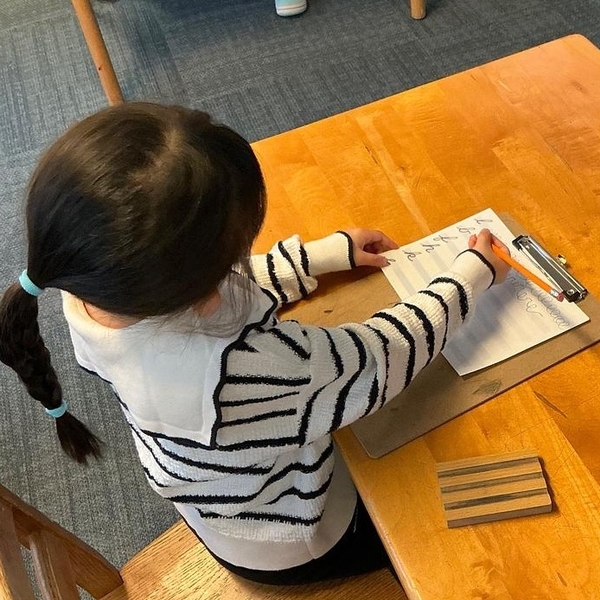
While today’s digital world feels dominated by keyboards and touchscreens, cursive handwriting remains an important and powerful tool for early childhood development. Supported by neuroscience and developmental psychology, as well as Montessori’s emphasis on hands-on learning and early literacy skills, learning cursive is a vital and intentional part of Springmont’s curriculum.
Long ago, Dr. Montessori understood that the hand is a tool for the mind. Today, studies show that writing in cursive simultaneously activates multiple regions of the brain, thereby improving synchrony between the left and right hemispheres (Frontiers Study). This integration stimulates brain synapses and helps children build stronger neural pathways associated with learning, memory and retention, reading comprehension and language processing, and focus and concentration. Neuroscience research from the Norwegian University of Science and Technology confirms that handwriting—especially cursive—boosts brain connectivity more than typing (Neuroscience News).
Key Reasons for Teaching Cursive
- Fine Motor Skills: Writing in cursive involves continuous, fluid movements that are more compatible with the natural development of fine motor skills. Unlike print, which requires children to frequently lift their pencils and make separate, disconnected strokes, cursive writing encourages smoother hand motions. This fluidity strengthens hand muscles, refines control, and helps children develop hand-eye coordination, preparing them for more advanced fine-motor tasks. Cursive’s smooth, rhythmic motions also allow children to write faster and focus more on their thoughts than on forming individual letters (The OT Toolbox).
- Focus & Retention: Because it requires deliberate, continuous motion, cursive writing can increase focus and mindfulness. This mindful engagement fosters patience, persistence, and intrinsic motivation—qualities that extend beyond handwriting into all areas of learning. In addition, studies of older students show that notes taken by hand are processed more deeply and are more likely to transfer to long-term memory than notes taken using a keyboard.
- Support for Reading & Writing: Because cursive letters are connected, children more easily see letter patterns within words and recognize words as whole units, rather than isolated symbols, which aids in the transition from decoding to fluent reading. Montessori teachers often pair cursive writing with phonetic awareness activities, allowing children to connect the shape and sound of letters in a meaningful, multisensory way. Unlike print writing, which can result in letter reversals (think b/d, p/q, and f/t), cursive letters are distinct, reducing confusion and frustration. A study published in PLOS ONE showed that first-grade students who received cursive instruction performed better in reading and writing assessments than those who did not (PLOS ONE Study).

3 days ago
4 days ago