
News
News
At Springmont, we’re proud of our school and like to share the accomplishments of our students, alumni, faculty, and staff. Here you’ll find information about Springmont, including recent school news, articles about our curriculum, and other interesting items. For additional press or media information, please contact Julie Strickland jstrickland@springmont.com or 404.252.3910.
Ask a Division Head: Why Have 3-Hour Work Periods When Children Have Such Short Attention Spans?
October 30, 2017
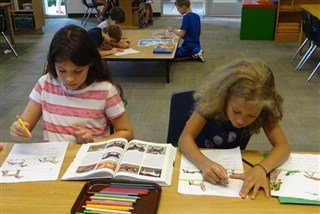
We strive for three-hour work periods in Primary classrooms precisely because young children have such short attention spans! Studies show that children, and adults, need uninterrupted time to choose and complete challenging activities and to build concentration. Dr. Mihaly Csikszentmihalyi writes extensively about the Flow theory - “Flow is a state of concentration and engagement that can be achieved when completing a task that challenges one’s skills.” When one becomes completely absorbed in his task, time becomes irrelevant and he experiences great pleasure and satisfaction. Children need uninterrupted time to become absorbed in their chosen tasks to experience and sustain this state.
Most Primary children begin their work period with “comfort work” – a task that has already been mastered. The child is confident he can complete the task well, giving him time to settle in and let his mind consider his next tasks. His next few choices will build in complexity, engagement and concentration. He will choose more challenging activities and repeat newly given lessons. After some sustained work, he will begin to lose this forward momentum. Interestingly, this happens for many children at about the same time each day. We suddenly notice more movement in the class, more Practical Life activities being chosen by older children and more social exchanges happening, often resulting in a louder classroom. The children are taking some “down time” to reflect on their previous work choices and to solidify their newly gained knowledge. But, they are not finished working. Maria Montessori observed that by allowing children time for this “false fatigue”, they will then choose the most challenging work of the whole three-hour work period. This is when the greatest learning takes place, but only because the children were previously allowed the time to settle-in, to choose and repeat work, to build upon skills and to rest as needed. Arbitrarily moving children through adult-led activities does not provide the same natural joy nor does it produce the same high-quality work and mastery.
When children transition to Springmont’s Lower Elementary program, they take these critical time-management skills with them. They are prepared for activities that take extended periods of concentration, such as researching, writing about and creating models of American landmarks in Chris’ class. The joy of achievement becomes the desire to do the longest division problem with a three-digit divisor in Livia’s class. The standard for high-quality work turns into the beautifully decorated research project in Patricia’s class. Your children experience the pleasure and satisfaction of “flow,” becoming effective and engaged learners.

1 day ago
2 days ago